


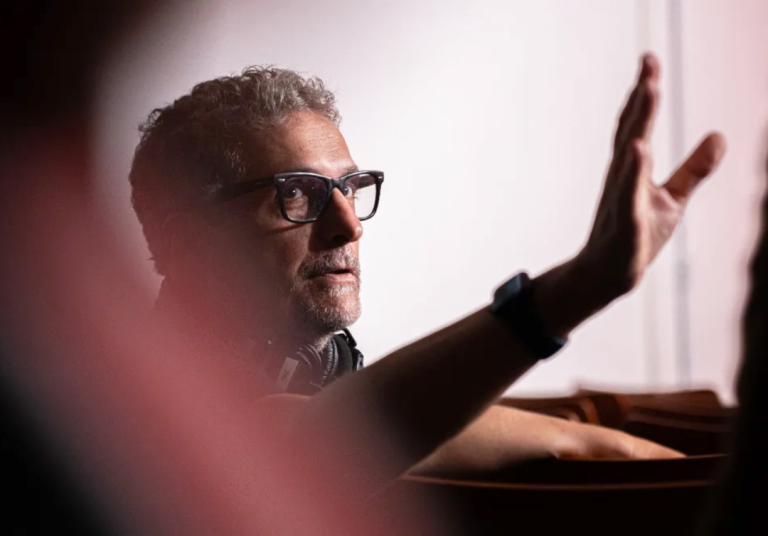
Meet the patron and discover the 2026 selection
Brazilian filmmaker Kleber Mendonça Filho is the patron of this year’s Atlas Workshops, taking place in Marrakech from November 22 to 26 during the 23rd
Opinions by Charles Ayetan
When referring to film industries across Africa, expressions like ‘African cinema’ or ‘cinemas of Africa’ are often used interchangeably in both the singular and the plural. This raises an interesting question: what is the most accurate term to capture film production across the continent?
Debating the right terminology for African filmmaking might seem, at first glance, like a minor issue of phrasing or semantic hair-splitting. However, the choice is far from trivial: shifting from ‘cinema’ in the singular to the plural completely changes the conversation.
This question has stayed with me for two decades, frequently resurfacing in discussions and publications dedicated to the continent’s film industry. As a result, terms like ‘African cinema,’ ‘cinemas of Africa,’ and ‘African cinemas’ are often used interchangeably.
Between Perspectives and Perceptions
Indeed, using the singular to describe the film industries of a continent made up of fifty-four countries feels misaligned with reality. Differences in perspective, narrative and aesthetic styles, temporal and spatial settings, historical contexts, and distinct artistic movements all point to a landscape of fundamentally diverse film traditions.
On the one hand, African films are far from aesthetically uniform. Depending on the national context, some prioritize social critique, while others embrace melodrama, comedy, experimental styles, or the exploration of political memory.
On the other hand, economic factors further amplify this diversity. Independent projects, commercial industries, and films backed by various funding sources operate with vastly different budgets and distribution networks.
This plurality feeds diverse imaginations and storytelling approaches shaped by local and national contexts. Senegalese cinema, for instance—most notably through the groundbreaking films of Ousmane Sembène—has traditionally centered on social critiques, power dynamics, and decolonization. Nigeria, on the other hand, birthed Nollywood—a booming commercial movie industry defined by its massive output and unique distribution networks. Nollywood offers both local and global audiences vibrant stories rooted in the customs, traditions, and everyday realities of Nigerian society and the broader African continent.
A Plural Africa, Plural Film Industries
There are also the vibrant national cinemas of other countries across the continent—such as South Africa, Algeria, Mali, Morocco, Tunisia, Egypt, Burkina Faso, and Ivory Coast—not to mention nations like Togo, whose film production remains modest or lesser-known.
African filmmakers have never presented a monolithic view of the continent. Pioneer critics and historians like Paulin Soumanou Vieyra and Tahar Cheriaa, among many others, played a vital role in documenting and celebrating the vast richness of African cinema.
Vieyra, a filmmaker and critic, left behind a documentary legacy that highlights the history and diversity of African film, most notably through his book published in 1975, Le Cinéma africain, des origines à 1973 (African Cinema, from Its Origins to 1973). Although the title uses the singular ‘cinema,’ this choice reflects the shared history of African nations, deeply shaped by colonialism through the post-independence era.
Shared Histories
Filmmakers like Ousmane Sembène (Senegal), Souleymane Cissé (Mali), Mohamed Lakhdar-Hamina (Algeria), Désiré Écaré (Ivory Coast), Moustapha Alassane, and Oumarou Ganda (Niger), among countless others, created vastly distinct bodies of work. Yet, they often grappled with shared historical and societal themes: decolonization, power structures, social inequality, women’s rights, tradition, the rise of new elites, dictatorship, corruption, and the shifting dynamics of modern society.
Ousmane Sembène’s Borom Sarret (Senegal) is not Mohamed Lakhdar-Hamina’s The Winds of the Aures (Algeria), any more than Souleymane Cissé’s Baara (Mali) is Désiré Écaré’s Faces of Women (Ivory Coast).
Through their production contexts, aesthetic choices, narratives, and distinct perspectives on African societies, these works reflect a rich diversity of cinematic traditions. It would therefore be reductive to pigeonhole them into a single category, as if there were a one-size-fits-all model of ‘African film.
Imaginaries and Aesthetics
It is precisely this rich diversity that compels us to look beyond the singular and embrace the continent’s filmmaking in all its plurality. Rather than a singular ‘African cinema,’ we must speak of African cinemas, each driven by distinct histories, sensibilities, aesthetics, and trajectories.
The plural, therefore, is not merely a question of vocabulary; it offers a far more accurate and nuanced way to conceptualize, define, and appreciate African film.
Consequently, using the singular risks flattening the diverse realities of African filmmaking and reinforcing stereotypes about a monolithic cinematic identity. The plural, by contrast, adopts a far more inclusive perspective, one that respects national distinctions while highlighting connections with global cinema.
Speaking of the ‘cinemas of Africa’ allows us to honor the distinct characteristics of each regional film scene without reducing the continent’s output to a single, homogenous identity. This choice of terminology fosters a more nuanced, accurate analysis of Africa’s rich and varied cinematic landscape.
It is therefore both essential and legitimate to recognize the wide array of narrative forms, aesthetic choices, creative vision, and historical experiences that shape African filmmaking.
Charles AYETAN, Togo
A journalist and film critic, Charles Ayetan is the author of numerous articles and a film criticism instructor. A founding member of the Association of Journalists and Film Critics of Togo (AJCC), he has served on the ecumenical jury at Cannes, Berlin, and Oberhausen, and on the critics’ jury at Carthage and Ismailia.
Brazilian filmmaker Kleber Mendonça Filho is the patron of this year’s Atlas Workshops, taking place in Marrakech from November 22 to 26 during the 23rd
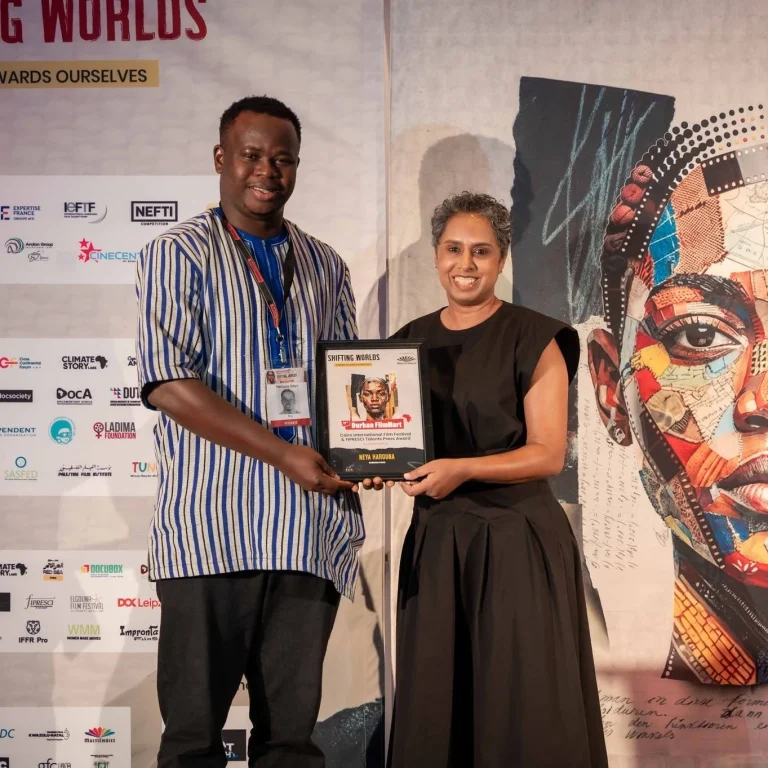
Neya Harouna emerged as one of the standout figures of Talents Durban 2026, taking home the Talent Press Award—a mentorship program dedicated to film criticism.